
59. What does this justification do?
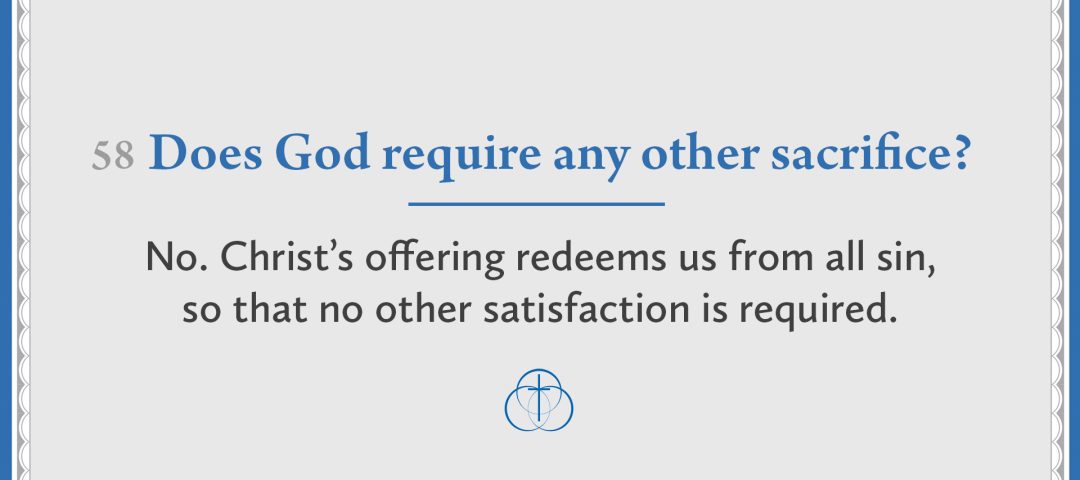
It grants us pardon for sin.
—
In Romans 4, Paul speaks in depth about justification by turning to the story of Abraham, one of Paul’s favorite models of faith in God and its consequences. There he quotes Genesis 15:6: “Abraham believed God, and it was reckoned to him as righteousness” (Rom. 4:3). Some theological traditions use this as a launching off point for their teaching that when we come to faith in Christ, God “imputes” to us all of Christ’s righteousness, such that God requires us to have none of our own to acquit us at the last judgment. Wesley read the passage far more carefully. He recognized that what Paul was talking about was, very simply, pardon for past transgressions. This is precisely what Paul himself goes on to say in Romans 4:6–8. Trusting what God has done for us in Christ means the wiping clean of the slate of our sins—because we have come to recognize that this is what God was doing “in Christ, reconciling the world to himself ” (2 Cor. 5:19). Paul will reinforce this a little later in Romans 5:9–10, where being “justified” is equated with “being reconciled to God.” Thus, a proper understanding of the very important theological term justification is that this is what gets us started in our new life with God or, better, ends our life of alienation from God.
And with the pardon of the guilt—and dismissal thereby of the consequences (standing under the wrath of God)—comes deliverance from all slavish fear of God, which is replaced by confidence that God is favorably disposed to bring to completion the work that God has begun in us. This is all very important because Wesley realized—in a way that many evangelical preachers have missed—that “justification” is not “salvation.” Justification is the boarding of the train that leads to salvation. The conductor of this train is the Holy Spirit, and the track it follows is sanctification.
—
So also David speaks of the blessedness of those to whom God reckons righteousness irrespective of works: “Blessed are those whose iniquities are forgiven, and whose sins are covered; blessed is the one against whom the Lord will not reckon sin.” (Rom. 4:6–8)
God shows his love for us in that while we were still sinners, Christ died for us. Since, therefore, we have now been justified by his blood, much more shall we be saved by him from the wrath of God. For if while we were enemies we were reconciled to God by the death of his Son, much more, now that we are reconciled, shall we be saved by his life. (Rom. 5:8–10 ESV)
This is love: not that we loved God, but that he loved us and sent his Son as an atoning sacrifice for our sins. (1 John 4:10 NIV)
See also Gen. 15:6; Ps. 32:1–2; John 1:29; Rom. 1:16–17; Heb. 9:26; 1 Peter 1:18–19; 2:24; 1 John 2:2; D&D ¶ 102 § 5
—
 This is an excerpt from Christian Faith and Doctrine: An Annotated Catechism for the Global Methodist Church. Seedbed is pleased to partner with The Global Methodist Church to offer this companion resource to A Catechism of Christian Faith and Doctrine for the Global Methodist Church.
Perfect for:
- Teachers and leaders discipling and catechizing others
- New Believers in the Global Methodist Church and Christianity in general
- Seekers curious about the Christian faith or the Wesleyan tradition
This resource will help you:
- Encounter faithful teaching about God’s character and his saving work in our world
- Train disciples to understand, recall, profess, and enjoy the church’s essential teachings
- Understand and internalize the beauty of historic orthodoxy
- Become catechized in the richness of Wesleyan faith and practice